Auschwitz . . . that dark word that calls to mind the horrific deeds done to the Jews and eventually extermination that we all learned about during the years of WW2. Auschwitz . . . the largest of all concentration camps and whose main goal was focused on extermination of the Jewish race. Auschwitz . . . the pain, sorrow and evil that we word encompasses . . . it was a trip I was determined to make while living in Germany and one I did not look forward to.
I had been warned to be prepared . . . "it is painful" they said . . . nothing could have prepared me for what I saw before my eyes and what I heard and read about the dreadful place . . .
(Cell "blocks" in Auschwitz I camp)
Mostly Auschwitz is seen as just an extermination camp, however it consisted of Auschwitz I (the original camp and prison originally constructed to hold Polish political prisoners), Auschwitz II–Birkenau (a combination concentration / extermination camp with a railroad running through the center and complete with four gas chambers/crematoriums), Auschwitz III–Monowitz (a labor camp to staff an IG Farben factory), and 45 satellite camps. Auschwitz I contained a series of buildings to hold prisoners as well as facilitate human experimentation. It was here that we learned of the sole purpose of one block was to experiment with making women sterile. Mostly the subjects were tortured with inhumane experimentation with the final result of death. In other blocks experimentation was done on children, mainly twins. There was a hospital which meant sure death if one were to find him or herself there, a "death wall" were executions took place, dark prison cells were prisoners were left in the dark for weeks on end, starvation cells where they were left to starve to death and standing cells were there was only enough room for the prisoner to stand. Were were told of hangings, of manual labor with little to eat and shown pictures of emaciated prisoners.

It was here in this camp (Auschwitz I) where the Holocaust Memorial and Museum are now held. The gates to the camp reads
Arbeit macht frei ("Work brings freedom"). It was in Auschwitz I, in one of the cell "blocks", that I stood before piles and piles of human hair with tears swimming in my eyes. The hair was collected and used to make a certain type of fabric for soldiers socks as well as other useful items. It was here that I saw a room full of discarded shoes, children and adults alike . . .glasses . . toothbrush and shaving materials . . . human possessions. Many of the victims were told that they were only being moved to a different location and therefore brought their few belongings with them only to have them stripped from them and sent back to the Germans. It was here where the one surviving gas chamber and crematorium are located. The chamber was dark and

quite out of respect for it's victims. There was a single vase of flowers in the room for a memorial. Several cut outs in the ceiling were proof of where the Zyklon B was dropped to the death of those inside. In the adjacent room were two furnaces to burn the bodies. Unbelievable . . . it felt as if I were just kicked in the stomach . . . my heart was aching . . . how in the world could this have happened and only 70 years ago!
(the luggage of hundreds of thousands of victims)
(electric fences surrounding Auschwitz I . . . we were told may people in both Auschwitz I and Auschwitz II-Birkenau would choose to end their lives by jumping into the electric fences than to go on with the torture they were being put through)

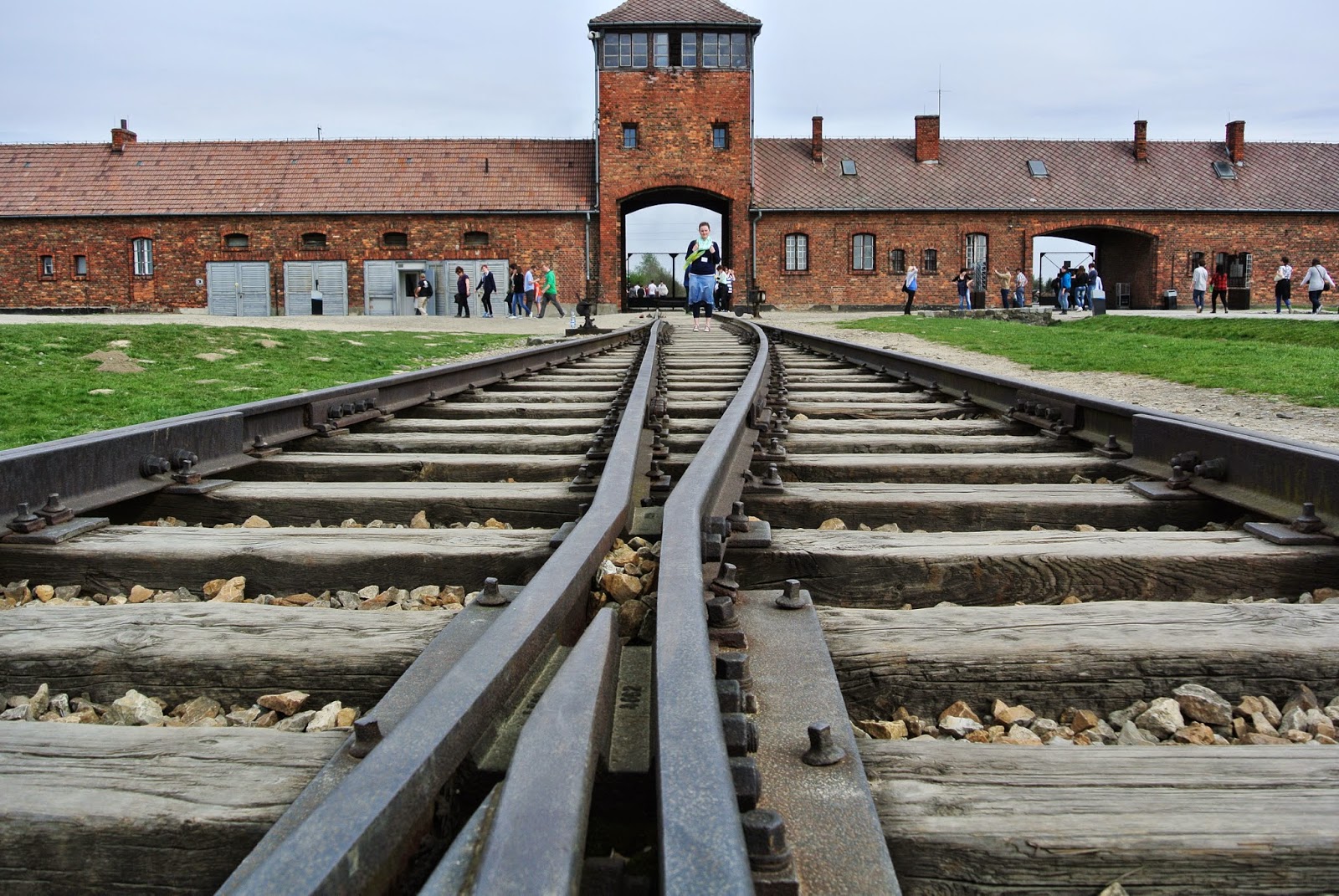
We next made our way to Auschwitz II-Birkenau, the largest of the camps and located very close to Auschwitz I. Here is where the majority of the extermination of the Jews took place with the railroad running straight through the camp for easy access. There were four gas chambers/crematorium held at this camp. These were destroyed by the Nazi's on there way out of Auschwitz in an attempt to hide the crimes that were done here. We were able to see the remains of these sites as well as some of the brick buildings set up for the women prisoners. The men's barracks were mostly made of wood and therefore destroyed in the last 70 years but a few had been rebuilt in order for visitors to view the living conditions. The size of the camp astounded me . . . so many buildings . . . so much barbed wire . . so much death . . .
(train tracks through the center of Auschwitz II-Birkenau)
(memorial to the victims at Auschwitz II-Birkenau)
It is difficult to tell the exact amount of lives that Auschwitz claimed as there were not accurate ledgers near the end of the war. Prisoners and victims no longer had their names or numbers taken down in registers, mass graves were ordered to be uncovered and the bodies burned as well as documents destroyed. The best estimation that has been established over the years is that Auschwitz claimed approximately 1.1 million lives. Approximately 1 in 6 Jews that died during the Holocaust took place in Auschwitz. Other victims of this camp included non-Jewish Poles, Soviet POW's as well as 31,000 to 36,000 people from other nations.
(map of the many places throughout Europe that prisoners and victims were brought from to Auschwitz)
It was a difficult visit, yet I believe a very important one. As George Santayana put it "The one who does not remember history is bound to live through it again." Clayton and I bought two books at the camp site that recall the memories of two victims of Auschwitz who made it through the Holocaust and went on to record their stories. I am currently reading
Hope is the Last to Die by Halina Birenbaum and would definately recommend it. Halina was an 11 year old Polish Jew who spent the occupation in the Warsaw Ghetto and in the concentration camps at Majdanek, Auschwitz, Ravensbruck and Neustad-Glewe where she was freed in 1945 at the age of 15 years old. That anyone should have to go through what this little girl went through blows my mind. The other book that was highly recommended by our tour guide is
This Way for the Gas, Ladies and Gentlemen written by Tadeusz Borowski.
If you are planning a trip to Krakow and Auschwitz I would suggest taking the tour with one of the many tourist info shops throughout Krakow. We were originally going to drive ourselves there since we had a rental car and just pay to get into the museum. I am glad we went with the tour company as it was only about $30 and included the transportation there and a guide for both Auschwitz I and Auschwitz II. Our guide was very knowledgeable and passionate about the subject. There were about 30 of us to one group but we were provided with headsets allowing us to hear what was said though we were in different rooms or parts of a cell "block".

 The fog and mist were rolling into the small town of Portmagee, Co. Kerry as we boarded the small vessel which would take us to our destination. Twelve was the designated number in our boat. The village was small, brightly colored and slightly windswept. The country surrounding Portmagee was emerald and somewhat wild in appearance. The wind was picking up pace ever so slightly as we headed out to sea. This was going to be a fantastic day! A one way trip to Skellig Michael took roughly 45 minutes in which the rain and wind increased throughout our journey. Wet and exhilarated, we finally landed on the island at the base of 600 roughly shaped slate steps leading to the 8th century monastery located at the top. The trip up was tedious, one wrong step could have you plummeting 600 feet to the sea below. A few breaks were in order to catch our breath and take in the beauty surrounding us. It was hot on the island and scarves, hats and jackets had to be removed on our ascent. The steps also seemed to get smaller, less sturdy and more precarious the higher we climbed. At long last we made it to the top. The views were out of this world! It was well worth the climb!