Monday, April 22, 2013

In Memoriam . . .


Several weeks ago Clayton and I had the opportunity to visit the Luxembourg American Cemetery and Memorial in honor of those who had lost their lives during WW2, most during the Battle of the Bulge which was fought in the winter of 1944 and spring of 1945. There are 5,076 headstones set in 9 plots of land.  It is in this cemetery where General George S. Patton Jr. is laid to rest.


As we walked throughout the cemetery we encountered several brothers who are buried side by side . . . there were also headstones with the Stars of David in honor of those Jewish soldiers who had fallen during battle.  It is customary for those family members visiting the graves of a Jewish kin to leave a small stone on the top of the headstone.


We also visited the nearby German cemetery and were struck by the comparison. There double the amount of graves (10.913) and one fourth the amount of headstones as there were four names to each headstone.  The headstones were not white marble, as was the American Cemetery, but rather made of cement.


We left with a heaviness in our spirits . . . remembering and thanking those who gave their lives . . .


"Grant us grace fearlessly to contend against evil and to make no peace with oppression"

"Take unto thyself O Lord the souls of the valorous that they may dwell in thy glory"


Monday, March 25, 2013

WWII history weekend

(Mardasson Memorial)
 
Along with the walk in the steps of the 82nd Airborne Division we also visited several sites of WWII history that weekend.  One such site was in Bastogne, Belgium.  Bastogne was critical to the success of the American forces in the Battle of the Bulge and it was here that the 101st division (famous in the Band of Brothers series) held off the advances of the German Army until relieved by General Patton.  There is a memorial set up in Bastogne (Mardasson Memorial) in honor the 76,890 American soldiers who were hurt or killed during the Battle of the Bulge. 


 (Sherman Tank "Thunderbolt" at the Mardasson Memorial)

We also found a memorial in honor of the 101st Airborne and more specifically "E" company. 


We then visited the forest on the outskirts of Foy where "E" company was camped and withstood the bombings of the German forces.  Many foxholes that were dug during the war are still present today and we heard if you take a metal detector you can even find some shrapnel left over. . . . we did not have a metal detector however, so Clayton took to digging with his hands . . hehe. . . the only bit of metal we were able to find was a can of Red Bull.


 (trees blow apart at Foy. . . not sure how much was original and how much was created for tourists) 


 (foxhole in the forest outside of Foy)
 
 
(our trek into the forest . . . you can tell we weren't the only ones to visit the site)
 
(another large foxhole we found)

Thursday, March 14, 2013

In the footsteps of the 82nd Airborne Division


On February 23rd Clayton and I decided to undertake a 13.6 mile walk through snow, mud, ice and treacherous terrain in retracing the steps of the 82nd Airborne during the Battle of the Bulge (more specifically the 505th parachute infantry regiment and the 551st parachute infantry battalion). Boy, what an experience it was!! The path we took lead us through the villages of Basse-Bodeux, Fosse, Grand-Halleux, Rochelinval, Dairomont and Reharmont. With nothing more than a few snacks packed in a backpack and a cup of vegetable soup for lunch, we proceeded to cover the same ground that these parachute infantries covered in a span of 4 days . . . only we did it in a total of 6 hours (of course we were not fighting for our lives at the time).


One of the highlights of the trip was a remembrance ceremony that took place in Fosse where we were able to meet two veterans of the 505th parachute infantry regiment who fought there.


The battle in Rochelinval cost the 551st more than half of its remaining men as the 551st were ordered to attack the village over open ground ant without artillery support. After this battle the 551st was absorbed into the 82nd Airborne Division as out of the initial strength of 800 officers and enlisted only 110 were left. The battalion was awarded a Presidential Unit Citation in 2001 recognizing its accomplishment. According to paratrooper Don Garrigues their first days in the Battle of the Bulge were miserable: "no sleep, frozen feet, trench foot, knee deep snot, cold food and hallucinations." The frozen feet and knee deep snow we were first hand witness to.


Arriving back to the mini we were thoroughly soaked, freezing, exhausted and convinced that we did not wish to experience any more "steps" in anyone’s division.


(Special thank you to my co-worker Ann Shields for posting the announcement at work and for the many handouts/books she gave me on the subject.  You Rock!!)

Monday, February 25, 2013

Amsterdam in a day


On January 5 we went to the city of Amsterdam (the largest city and the capital of the Netherlands) . . . . what can I say about Amsterdam that is not inappropriate to post on my blog. . ?!?

I guess I could tell you about the historical buildings of Amsterdam . . . It was here in Amsterdam that the Frank family hid in the walls of one small house and where the diary of Anne Frank was written.  We were able to view that same house from the outside as well as a statue of Anne Frank.  Had we wanted to see the inside bad enough we could have stood in a line that was several hours long . . . we decided, however, that it would be more beneficial to see the rest of the city as we were only there on a day tour.

Westerkerk is a protestant chrurch built from 1620-1631.  It is here in this church where the famous artist Rembrandt Van Rijn is buried. We were able to find a bit of piece inside this church as we sat and enjoyed the music and remaining Christmas decorations.


We walked by the Royal Palace, which is one of three palaces in the Netherlands at the disposal of Queen Beatrix by Act of Parliament. The palace was built as a city hall during the Dutch Golden Age in the 17th century. The palace is open to visitors most of the year . . . just not when we were there. . .

Amsterdam is built on a series of canals which makes the city quite lovely.  There are also more bikes than cars.

 
There is a 1956 World War 2 monument set up on Dam Square which was quite moving. In the words of Wikipedia,” The central element of the monument is a concrete conical pillar 22 metres in height, covered entirely by white travertine stone. On the front of the pillar is a relief entitled De Vrede ("Peace"), consisting of four chained male figures, representing the suffering endured during the war. To either side of these central figures are two male sculptures representing members of the Dutch resistance, the left figure symbolizing the resistance by the intelligentsia and the right figure symbolizing the resistance by the working classes. Weeping dogs are at their feet, representing suffering and loyalty. Above the central relief is a sculpture of a woman with a child in her arms and doves flying around her, representing victory, peace, and new life. A relief of the back side of the pillar shows doves ascending into the sky, symbolizing the liberation.”

 
The red light district is as crazy as everything you have heard . . . and we witness it all . . . probably not going back.  *yikes* There are comfy “coffee shops” which specialize in a product other than “coffee”.  Window shopping has a whole new meaning in Amsterdam.  *double yikes* Even the tourist shops throughout the city held many different items that should only be seen in the back corner of some dark, dingy, heavily guarded against anyone-younger-than-18 store.  I was in a state of shock and it was with a sigh of relief that I left that city . . . it is probably a lovely place in the summer . . I just don’t think I will go back to see if it is or not . . . 

On the way to the city, our tour bus stopped at a cheese factory that also produced the classic wooden clogs.  It was delightful! We were given demonstrations of how the clogs were made as well as the cheese.  We also received samples of the cheese which caused us to break down a buy a few.  I also bought a neat half-made shoe for the storage of my pens and pencils.


Sunday, February 24, 2013

Salzburg, Austria


While on our "Christmas" tour of Bavaria we decided on a little visit to Salzburg. The main highlight of this trip was to see the Hohensalzburg Castle . . . as well as the lovely Christmas market I was told about. We used our handy-dandy GPS to get us into the country but had no idea where to go after that. There were no clearly marked signs for Hohensalzburg Castle and we ended up driving in circles for about 30 min or so. We finally parked in the first place we could find at the base of the mountain and figured if we kept walking up we would eventually find it. . . and we did!! It was a little deserted as it was the day after Christmas and it was raining, but we were able to eat lunch as well as visit several rooms inside the fortress which were more like a museum of various items that would have been found during that time period.
 
(view of the Alps from inside the castle)
 
 
(Salzurg city)
 
 
(another view of the Alps)

Hohensalzburg is one of the largest castles in all of Europe and construction originally began in 1077. It was built atop the Festungsberg mountain (of which we managed to walk both up AND down) and has some interesting history. In the 19th century, it was used as barracks, storage depot and dungeon before being abandoned as a military outpost in 1861. It also served as a prison during World War I.

 
We then walked down into the city center for the fabulous Christmas market. It was huge!! My husband bought me a smallish ceramic mushroom for our house and we were able to visit the Salzburg Cathedral. We then walked all the way back to our car on the other side of the city. . . we must have walked about 4-5 miles that day. . .no joke!! I just asked Clayton! (he keeps me from exaggerating too much)

Saturday, January 26, 2013

Neuschwanstein and Hohenschwangau Castles


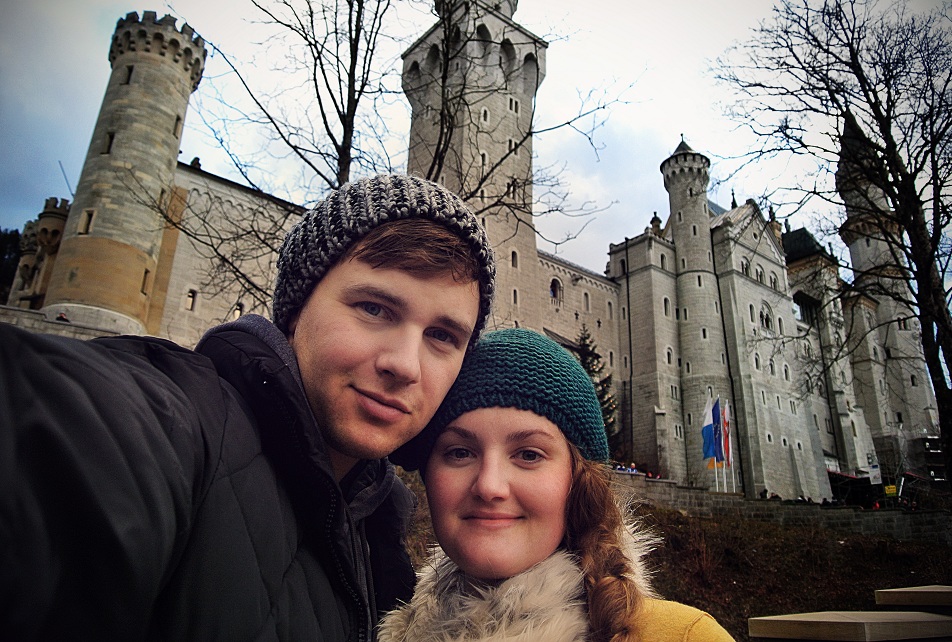
Shortly after Christmas we visited the fairy tale castles of Neuschwanstein and Hohenschwangau. They were amazing!! They are within walking distance of each other. . . which is what we did. . . a 30 min up-hill trek that left us exhausted, sweaty, red-faced and almost late for our tour. . .but i digress. . .

We first went to Hohenschwangau castle and since I am no history buff I have copied and pasted what Wikipedia has to say about it. .

"Hohenschwangau Castle was built on the remains of the fortress Schwangau, which was first mentioned in historical records dating from the 12th Century. A family of knights was responsible for the construction of the medieval fortress, and it served as the seat of the local government of Schwangau. In 1523, the schloss was described as having walls which were too thin to be useful for defensive purposes. After the demise of the knights in the 16th Century, the fortress changed hands several times. The decay of the fortress continued until it finally fell into ruins at the beginning of the 19th Century.

In April 1829, Crown Prince Maximilian (the later King Maximilian II of Bavaria) discovered the historic site during a walking tour and reacted enthusiastically to the beauty of the surrounding area. He acquired the ruins - then still known as Schwanstein - in 1832. In February 1833, the reconstruction of the Castle began, continuing until 1837, with additions up to 1855.

Hohenschwangau was the official summer and hunting residence of Maximilian, his wife Marie of Prussia, and their two sons Ludwig (the later King Ludwig II of Bavaria) and Otto (the later King Otto I of Bavaria)."

 
I can say that it was very beautiful inside and out! There were many fabulous "gifts" to the family on display throughout the castle. These "gifts" were such things as pure gold statues, carved ivory images, sterling silver table centerpieces intricately made, etc. Clayton stated that these gifts were "probably worth millions each!" but seemed to be diminished by the beauty and glory of the castle.


Our next stop (after the aforementioned 30 min walk) was Neuschwanstein castle. This castle was built in the 19th century for King Ludwig II who had grown up at Hohenschwangau castle. We were told that he was quite the romantic. His personal bedchamber was adorned with murals that told the story of Tristan and Isolde. This castle took over two decades to build (and was never really finished) but King Ludwig II only spent about 170 days in the castle before his untimely death. We were told that he was arrested at his home and claimed to be clinically insane due to being a recluse and spending extravagantly on his several castles. He was then found dead several months later in a lake along with this psychiatrist. Hummm . . . was it murder? Was it suicide? Apparently it is a mystery that only the royal family knows the answer to.


We were not supposed to photograph the inside of the castle, but the beauty was too great not to share. We went all "ninja" and snapped several photos without anyone being the wiser :-) This castle was also the inspiration behind Walt Disney's Cinderella castle and reminded me so much of the Beauty and the Beast castle on the inside. Anyone who knows me very well would know just how happy and excited I was during the tour of this amazing masterpiece.