Showing posts with label travel. Show all posts

Saturday, September 27, 2014

Lisbon ~ Portugal

Taking this one back to last September on our Costa Pacifica cruise with bro and sis . . . sometimes things get away from me . . . but here goes!

(downtown Lisbon)

 Our stop in Portugal was short . . . but definitely sweet!!  We disembarked to warm, sunny, beautiful weather waiting for us.  We had signed up for a Jeep off road excursion prior to disembarking and were quickly corralled to our awaiting vehicles.  Our specific Jeep was a nice shade of mustard yellow with open sides to allow the fresh air (and plenty of dirt and dust) to penetrate our minds and bodies. 


The scenery was simply fantastic!  After about a 20 minute drive to get out of the city we were met with great coastal views!  It really reminded me of our family's annual (or sometimes bi-annual) drive up the California coast to our favorite camping spot in Northern California.  We made several stops throughout the day in little villages as well as scenic, photo opportunistic locations.  The craziest thing of the day was the experience of riding in this "off road vehicle" on the freeway as we were making our way back to the port.  Completely unsafe!  The sides and back of the Jeep were open to air, there were no seat belts and we were sitting on benches in the back.  Imagine having six adults in the back of a pickup (with just a roof over the back) on bench seating riding down Highway 99 in the good ol'USA . . . would NEVER be allowed!!  But alas! There we were cruising down the highway, dust covered and stinking from a day of fun and adventure! Ha!


Friday, September 19, 2014

Normandy D-Day weekend


A four day weekend coming up??  Husband going back to the states for a job possibility??  I smell an impromptu weekend trip with a co-worker :-)

Normandy, France has been on my "must see" list since we arrived in Europe and with less than two months left here I had yet to visit it.

We decided to drive to Normandy as the train would have cost quite a bit and then we would have had to purchase a tour to drive us to all the sites . . . oh! did I mention we also took the dogs??  Yes, Mika and Milo went on a road trip to France . . . I wasn't too thrilled after the last road trip (see previous post) but I also had no dog sitter for them.  The drive was a good 8.5 hours getting there as my lovely GPS routed us through downtown Paris to escape from the traffic.  Instead of traffic we were stuck in a horrible nightmare of one lane roads, cars that drive way to close to one another and white knuckles.  At long last we arrive at our destination in time for a late meal (they allowed the pups to join us inside the restaurant . . under the table . . inside!!!) and then hit the hay.

The next day was jam packed with monuments, history and beautiful scenery!  The Normandy region is absolutely beautiful!  I was extremely surprised by the peacefulness that I found . . . I guess I expected such a war ravaged part of the country to be a little less appealing . . . it was lovely!  Our fist stop took us to the Overlord museum on the way to the American Cemetery.  The museum was packed full of helpful information as well as just about every type of tank, vehicle and war machine used during WWII by both the Allies and the Germans alike.  We then continued on to the
American cemetery which I found was much like the American cemetery in Luxembourg only with more monuments and a peaceful ocean breeze.  It was arranged in much the same way with the white stone crosses marking each burial site and a wall full of names for the lost soldiers.  We took a path straight from the cemetery down to Omaha Beach were most of the fighting took place on D-Day.  It was, again, very peaceful.  Nothing remained that would hint to the devastation that took place on this beach where over 2,400 American soldiers met their death. 


Mika and Milo had a hay day on the beach as we set them free of their leashes . . . the joy was written all over their cute and fuzzy faces.  Oh, the jumping!  Oh, the barking! Such pure bliss!


We then continued down the road to Pointe Du Hoc, a place I had only heard about from a previous co-worker and WWII history buff.  Honestly, I wasn't really expecting much but boy was I surprised!  It turned out to be my favorite stop during the trip! Pointe Du Hoc is a promontory with a 100 foot cliff that stood in between Omaha and Utah beaches.  The area was fortified by the German gun pits and concrete casements and was an important stronghold as they could threaten the Allied landings on both beaches.  On D-Day the American Rangers scaled the cliffs on rope ladders to overtake the Germans and destroy the guns.  The area was peppered with large craters from the repeated bombings, some 30 feet deep by 30 feet wide!  Several of the heavy gun housings were still intact and the bunker was surprisingly large.  To add to all of the fantastic remains of a not so distant war, the area was stunning in beauty!  The turquoise water against the steep cliff face took my breath away . . . if it had not been for the gusts of wind paired with a short, light weight skirt I could have stayed there for hours.


Our next stops took us to Utah Beach, Sainte-Mere-Eglise and a short drive through Caratan.  At Utah Beach the pups once again enjoyed their freedom!  They even took a picture with one of the memorials set up to honor the US Navy.  The beach had quite a bit more seashells than Omaha and the sand wasn't quite so soft. Sainte-Mere-Eglise was a small town near Utah beach which was famous as the landing spot of many of the paratroopers on D-Day and resulted in heavy casualties.  Many were caught up in utility poles and shot before they could cut themselves down.  A well known incident involved a paratrooper named John Steele who was caught up on the steeple of the town church.  Unable to do little else he hung from the spire for two hours pretending to be dead before the Germans took him prisoner.  He later escaped from the German camp and rejoined his division.  In memory of the event there is a paratrooper hanging from the spire to this day . . . of course this one is not real.
 

We stayed overnight two nights in Bayeux, France and I wish we had some more time to enjoy this quaint little town.  We were able to enjoy a traditional French dinner and visit the wonderful cathedral in town.  Bayeux is most famous for the Bayeux Tapestry made to commemorate the Norman Conquest of England in 1066.  Unfortunately we ran out of time and did not get a chance to see the tapestry.  I could have spent two days wandering the cobble stone streets, nibbling on eclairs and visiting the local boutiques that town had to offer . . . but alas . . . maybe next time?? Who knows . . if you are going on a Normandy trip, Bayeux is definitely worth the visit.

Tuesday, April 15, 2014

Auschwitz Concentration Camp ~ Poland

Auschwitz . . . that dark word that calls to mind the horrific deeds done to the Jews and eventually extermination that we all learned about during the years of WW2.  Auschwitz . . . the largest of all concentration camps and whose main goal was focused on extermination of the Jewish race.  Auschwitz . . . the pain, sorrow and evil that we word encompasses . . . it was a trip I was determined to make while living in Germany and one I did not look forward to.

I had been warned to be prepared . . . "it is painful" they said . . . nothing could have prepared me for what I saw before my eyes and what I heard and read about the dreadful place . . .

(Cell "blocks" in Auschwitz I camp)
Mostly Auschwitz is seen as just an extermination camp, however it consisted of Auschwitz I (the original camp and prison originally constructed to hold Polish political prisoners), Auschwitz II–Birkenau (a combination concentration / extermination camp with a railroad running through the center and complete with four gas chambers/crematoriums), Auschwitz III–Monowitz (a labor camp to staff an IG Farben factory), and 45 satellite camps.  Auschwitz I contained a series of buildings to hold prisoners as well as facilitate human experimentation.  It was here that we learned of the sole purpose of one block was to experiment with making women sterile.  Mostly the subjects were tortured with inhumane experimentation with the final result of death.  In other blocks experimentation was done on children, mainly twins.  There was a hospital which meant sure death if one were to find him or herself there, a "death wall" were executions took place, dark prison cells were prisoners were left in the dark for weeks on end, starvation cells where they were left to starve to death and standing cells were there was only enough room for the prisoner to stand.  Were were told of hangings, of manual labor with little to eat and shown pictures of emaciated prisoners.

It was here in this camp (Auschwitz I) where the Holocaust Memorial and Museum are now held.  The gates to the camp reads Arbeit macht frei ("Work brings freedom").  It was in Auschwitz I, in one of the cell "blocks", that I stood before piles and piles of human hair with tears swimming in my eyes.  The hair was collected and used to make a certain type of fabric for soldiers socks as well as other useful items. It was here that I saw a room full of discarded shoes, children and adults alike . . .glasses . . toothbrush and shaving materials . . . human possessions.  Many of the victims were told that they were only being moved to a different location and therefore brought their few belongings with them only to have them stripped from them and sent back to the Germans.  It was here where the one surviving gas chamber and crematorium are located.  The chamber was dark and
quite out of respect for it's victims.  There was a single vase of flowers in the room for a memorial.  Several cut outs in the ceiling were proof of where the Zyklon B was dropped to the death of those inside.  In the adjacent room were two furnaces to burn the bodies. Unbelievable . . . it felt as if I were just kicked in the stomach . . . my heart was aching . . . how in the world could this have happened and only 70 years ago!
 (the luggage of hundreds of thousands of victims)

(electric fences surrounding Auschwitz I . . . we were told may people in both Auschwitz I and Auschwitz II-Birkenau would choose to end their lives by jumping into the electric fences than to go on with the torture they were being put through)


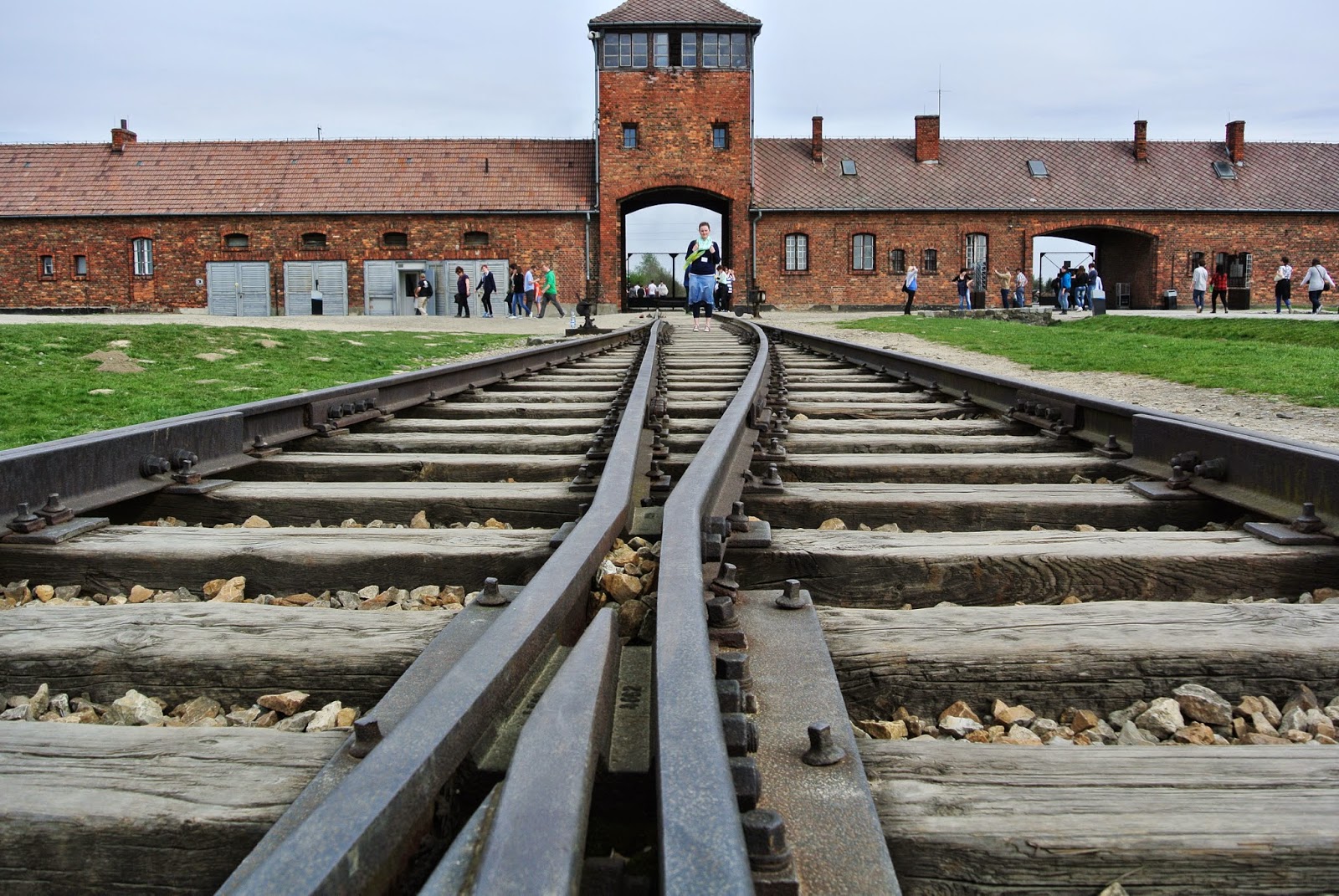
We next made our way to Auschwitz II-Birkenau, the largest of the camps and located very close to Auschwitz I.  Here is where the majority of the extermination of the Jews took place with the railroad running straight through the camp for easy access.  There were four gas chambers/crematorium held at this camp.  These were destroyed by the Nazi's on there way out of Auschwitz in an attempt to hide the crimes that were done here.  We were able to see the remains of these sites as well as some of the brick buildings set up for the women prisoners.  The men's barracks were mostly made of wood and therefore destroyed in the last 70 years but a few had been rebuilt in order for visitors to view the living conditions.  The size of the camp astounded me . . . so many buildings . . . so much barbed wire . . so much death . . .
 (train tracks through the center of Auschwitz II-Birkenau)
(memorial to the victims at Auschwitz II-Birkenau)


It is difficult to tell the exact amount of lives that Auschwitz claimed as there were not accurate ledgers near the end of the war.  Prisoners and victims no longer had their names or numbers taken down in registers, mass graves were ordered to be uncovered and the bodies burned as well as documents destroyed.  The best estimation that has been established over the years is that Auschwitz claimed approximately 1.1 million lives.  Approximately 1 in 6 Jews that died during the Holocaust took place in Auschwitz.  Other victims of this camp included non-Jewish Poles, Soviet POW's as well as 31,000 to 36,000 people from other nations.

(map of the many places throughout Europe that prisoners and victims were brought from to Auschwitz)

It was a difficult visit, yet I believe a very important one.  As George Santayana put it "The one who does not remember history is bound to live through it again."  Clayton and I bought two books at the camp site that recall the memories of two victims of Auschwitz who made it through the Holocaust and went on to record their stories.  I am currently reading Hope is the Last to Die by Halina Birenbaum and would definately recommend it.  Halina was an 11 year old Polish Jew who spent the occupation in the Warsaw Ghetto and in the concentration camps at Majdanek, Auschwitz, Ravensbruck and Neustad-Glewe where she was freed in 1945 at the age of 15 years old.  That anyone should have to go through what this little girl went through blows my mind.  The other book that was highly recommended by our tour guide is This Way for the Gas, Ladies and Gentlemen written by Tadeusz Borowski.

If you are planning a trip to Krakow and Auschwitz I would suggest taking the tour with one of the many tourist info shops throughout Krakow.  We were originally going to drive ourselves there since we had a rental car and just pay to get into the museum.  I am glad we went with the tour company as it was only about $30 and included the transportation there and a guide for both Auschwitz I and Auschwitz II.  Our guide was very knowledgeable and passionate about the subject.  There were about 30 of us to one group but we were provided with headsets allowing us to hear what was said though we were in different rooms or parts of a cell "block". 

Thursday, March 6, 2014

Spain . . . Splendid and Stunning

During our cruising aboard the Costa Pacifica we made several stops along the coast of Spain.  I decided to put them all in one blog post so that my readers would get the full Spain experience at once :-)


Cadiz, Spain


Our first stop was in Cadiz, Spain.  Cadiz is a port city located in southwestern Spain and is full of life and sun!  Cadiz is also the oldest continuously inhabited city in Spain and is one of eight provinces which make up the community of Andalusia. When we first found out we would be taking this cruise and stopping in Spain we had decided it was a must to lounge at a beach in Spain . . . ummm, boy were we wrong!  We first spent some time in the main square of Cadiz enjoying the live music/dancing, frozen yogurt and shops as well as meandering through the winding and narrow streets of the city.  The cathedral of Cadiz was and imposing structure which demanded our attention. We then changed into our swimming gear in the bathroom of a local eatery and headed off to find our beach!


La Playa de la Caleta ~ when I had done my research before the trip I had learned that this beach was the best loved beach in Cadiz.  It is a beach located in the Old city and is located between the castles of San Sebastian and Santa Catalina.  What could be better than being in Spain, at a beach, located Die Another Day.  It seemed to be the perfect choice for a beach at this stop as it was within walking distance from our cruise dock and the reviews were amazing!  The first thing we noticed upon arrival, however, was the density of people upon this certain beach.
It was packed!  The beach itself is not very large . . . about 1,300 feet long and 98 feet wide . . . all of it filled with tourists and Spaniards combined!  Well . . . "Let's give it a shot" we thought.  Finding a spot large enough to lay out our towels we then took in the surroundings . . . the setting was indeed beautiful!  A quaint beach situated between two extremely old castles, on the left side of the beach several boats were swaying with the tide, the sound of beach and touch of sun on our skin  . . . . we then noticed the nudity . . .
between castles??  I had also learned that it had a certain resemblance to parts of Havana, Cuba and was used as the set for several scenes in the James Bond movie
For those of you who have not been to a beach in Europe, it is quite common for bathers to bathe topless.  It is also quite common to find old and young men alike sporting the traditional "speedo".  We are not European, however, and ended up feeling quite uncomfortable in our surroundings.  Also . . the water was quite cool.
Back in town we were able to satisfy our American food cravings at a traditional, American "burger joint" (forgot the name of it at the moment) before heading back to the ship.  It was a beautiful day and the setting was superb!


Santiago de Compostela, Spain


Our next stop in Spain was at the port of Vigo, Spain . . . our main attraction that day?? The city of Santiago de Compostela and it's famous cathedral.  Just a short train ride away and we were walking the streets of this UNESCO World Heritage Site.  Legend has it that the remains of the apostle James were located here and the cathedral was then built upon the site of the remains.  The Cathedral of Santiago de Compostela has been the final destination of a pilgrimage that began over 1,000 years ago and is known as the Way of St. James.  Over 100,000 pilgrims travel to the city each year from across Europe as well as other parts of the world.  Surrounding the cathedral you can find many shops and stands selling the scallop shell, emblem of St. James.  Inside the cathedral there are backpacks and walking sticks stacked along the walls as pilgrims pay their respects (I guess we took the easy route . . no backpacks, tennis shoes or walking sticks for our group of 6).

The construction of the cathedral began in 1075 as was made in the Romanesque style with a Baroque façade.  It is truly beautiful and intricate . . . inside and out!  The first thing I noticed upon entering the cathedral, besides the number of people packed in such a small space, was a very large, and beautiful chandelier in the center of the cathedral.  The smell of incense greeted us and everything seemed to be overlaid with gold.  We stayed for part of the service before venturing back into the streets.

On our train ride back to the port we learned that the very same rail/route we were taking had an accident just a few months prior killing 79 people.  Apparently the train was exceeding the speed limitations and derailed on a bend as it approached the Compostela station . . . uhhh . . gee . . .thanks for informing me. :-/
 
Malaga, Spain


(roman ruins with the Alcazaba in the background)

Malaga, also a part of Andalusia, was our last stop in Spain during this voyage.  None of the shore excursions listed by our cruise where too tempting so we decided to just do this one on foot.  Clayton, not feeling well, decided to stay on the ship so Ryan, Kelly and I set off on our own adventure.  Malaga is the sixth largest city in Spain, located near the straight of Gibraltar and not very far from the African continent.  The history of Malaga dates back over 2,800 years making one of the oldest cities in the world.


The Roman theater of Malaga dates back to the 1st century B.C. and was only rediscovered in 1951.

The Castle of Gibralfaro, as well as the connecting Alcazaba, were built by the Moors in the early 11th century.  The Alcazaba was the fortification on the top of the hill Gibralfaro and was used for administrative and defensive operations.  It was also the residence of the royalty of that time.  The inner structure was filled with gardens, ponds and beautiful architecture . . . not the typical style of architecture we had seen in Europe up to this point.  I later learned that we could have actually taken a ferry across to Morocco for the day . . . complete with a camel ride!  Oh well . . .


Episcopal Palace
Monday, February 24, 2014

Corrie Ten Boom House ~ Haarlem, Netherlands

Back to our cruise last September . . . . first stop was Amsterdam.  Having been to Amsterdam once before, and not that impressed, we decided to take a short jaunt over to Haarlem to visit the Ten Boom house.  It was a short and pretty uncomplicated train ride from the center of Amsterdam into Haarlem.

The Ten Boom family is well known for their efforts in hiding Jews during WW2 in a hidden room on the top floor of their small little "beje" in Haarlem.  Mr. Ten Boom was a clockmaker and his shop was on the bottom floor of their little house. Corrie Ten Boom, the youngest of four children, lived in the house with her older sister Betsie and their father during the years of the Nazi invasion of the Netherlands.  They initially started out hiding their Jewish neighbors from persecution until they were able to connect with an underground network to find them a more secure, permanent residence.  As word spread more and more Jewish people started showing up at their doorstep looking for a safe place to escape.  They were able to move most of them out to homes in the country that were safe but some of the others that were harder to find safe houses ended up staying with them in their small home.  At one point they had 30 people in their house at one time. . . I did not realize the significance of this until I visited the house. . . it is truly a "tiny" place and a household of 3-4 people would be cramped in our standards much less having over 30 people at one time.  They eventually had the "hiding place" built in the top floor in case of a raid which would allow their 6 permanent Jewish guests a place of safety for at least a week if need be.  There was a small vent in the room and was stocked with water in the event it needed to be used for an extended period of time.  The room was behind a false wall in Corrie's bedroom and could only be accessed through a sliding panel in the plastered brick wall under the built in bookshelf.  It required you to crawl through to the other side on your hands and knees and had to be done within 1-2 minutes after the alarm the Ten Boom's had installed in their house had sounded.  All remnants of these guests must be removed with them and taken to the hiding place in a short amount of time.  They had practiced this routine over and over again until they had it perfected.  On February 28, 1944 it was no longer a drill.  The 6 guests were able to make it to the hiding place and avoid detection but the Ten Boom family was no so lucky.  They were taken into imprisonment where Mr. Ten Boom had died within a matter of 10 days and Betsie died later in Ravensbruck concentration camp.  Corrie was able to make it through the concentration camps and was released on a clerical error on December 28th 1944 to find out that all of their guests in the hiding place had made it out alive.  Corrie went on to set up rehabilitation centers in the Netherlands for refuges that had survived the concentration camps.  She became a public speaker and a writer of many books, her best selling book being The Hiding Place which recounted the story of the Nazi invasion, concentration camps and their work in sheltering the Jewish people.  I had read the book several months prior to the trip making this visit especially meaningful to me.  We were able to walk through the house, see first hand some items that were mentioned in the book and even crawl through the bookshelf to the "hidding place" behind the wall.  It was astonishing how small it really was.  The room is only 30 inches deep . . . unbelievable!  It was a touching visit and I am so very thankful we were able to see this first hand . . the memories
will last forever.
The Hiding Place

We then wandered the streets of Amsterdam and I have to say the weather makes all the difference in the world!!!  The Amsterdam we had experienced in the past was kinda creepy . . . inappropriate views at every turn . . . this time we avoided the bad and spent our time wandering the streets in mostly sunlight and ending the day on a canal cruise through the city.  It was a lot of fun!  The city of bikes made it's way up in my opinion after this trip.  I wouldn't mind going back . . it has a certain charm to it with many Renaissance styled buildings and old city houses lining the canals.